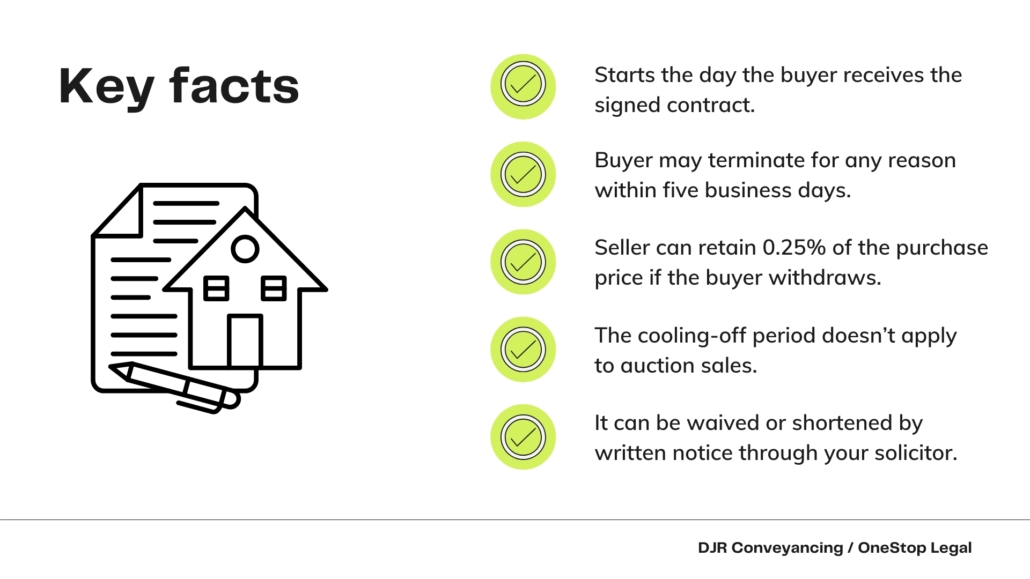
When purchasing residential property in Queensland, you’re entitled to a five-business-day cooling-off period under the Property Occupations Act 2014 (Qld). This allows you to change your mind for any reason within that period.
Local Relevance – Gold Coast Market
Gold Coast contracts often include short deadlines due to high competition and off-the-plan sales in booming areas such as Surfers Paradise, Palm Beach, and Broadbeach.
Our experienced conveyancers help you understand your cooling-off rights before signing — whether you’re purchasing a unit, house, or investment property.
💡 Tip: Always seek advice before signing a contract to ensure your rights and cooling-off options are protected.
DJR Conveyancing offers fast, local assistance for all Gold Coast conveyancing matters.
https://djrconveyancing.com.au/wp-content/uploads/2025/11/cooling-off-period-property-contracts-.jpg10801080DJRhttps://djrconveyancing.com.au/wp-content/uploads/2019/12/DJR-Logo-e1577417399527.pngDJR2025-11-13 13:45:302025-11-13 13:45:30Cooling-Off Period Gold Coast – What You Need to Know
Buying or selling a property on the Gold Coast involves more than signing a contract it requires the legal transfer of ownership known as conveyancing.
At DJR Conveyancing, we make this process simple and stress-free for property buyers and sellers across Broadbeach, Robina, Surfers Paradise, Burleigh Heads, and all of Queensland.
What Does a Conveyancer Do?
A Queensland conveyancer handles all legal, financial and administrative steps required for a valid property transfer.
We:
Review and explain your contract of sale so you understand your rights and obligations.
Conduct thorough property searches including title, rates, water, and body corporate records.
Manage all key contract dates such as finance approval, building and pest inspections, and settlement deadlines.
Prepare settlement statements and transfer documents accurately and efficiently.
https://djrconveyancing.com.au/wp-content/uploads/2020/02/AdobeStock_239322052-Converted.jpg8001200DJRhttps://djrconveyancing.com.au/wp-content/uploads/2019/12/DJR-Logo-e1577417399527.pngDJR2025-10-29 15:00:282025-10-29 15:00:28What Is Conveyancing in Queensland?
Starting 1 January 2025, significant changes to the Foreign Resident Capital Gains Withholding (FRCGW) rules will affect all property sellers in Australia. These changes are designed to ensure that foreign residents meet their tax obligations when selling Australian property but have implications for all sellers, regardless of residency status.
Key Changes Effective from 1 January 2025:
Increased Withholding Rate:
The withholding tax rate will rise from 12.5% to 15% of the property’s sale price.
Removal of the $750,000 Threshold:
Previously, the withholding rules applied only to properties sold for $750,000 or more. This threshold has been eliminated, meaning the withholding requirements now apply to all property sales, regardless of the transaction value.
Implications for Sellers:
Australian Resident Sellers:
To avoid the 15% withholding, Australian residents must obtain a clearance certificate from the Australian Taxation Office (ATO) and provide it to the buyer before settlement.
If a clearance certificate is not provided, the buyer is legally required to withhold 15% of the purchase price and remit it to the ATO.
Obtaining a clearance certificate is free, typically valid for 12 months, and can be applied for online. It’s advisable to apply early, as processing can take up to 28 days.
Foreign Resident Sellers:
Foreign residents selling property in Australia are subject to the 15% withholding. They may apply for a variation if the withholding amount is inappropriate for their tax situation.
Action Steps for Sellers:
Apply for a Clearance Certificate Early:
Visit the ATO’s website to apply for the certificate as soon as you decide to sell your property.
Inform Your Conveyancer or Legal Advisor:
Ensure your legal representatives are aware of these changes to guide you appropriately through the transaction.
Communicate with the Buyer:
Provide the clearance certificate to the buyer before settlement to prevent any withholding.
By staying informed and proactive, sellers can navigate these changes effectively and avoid unexpected financial implications during property transactions.
For comprehensive information on the upcoming changes to the Foreign Resident Capital Gains Withholding (FRCGW) rules effective from 1 January 2025, please refer to the Australian Taxation Office’s official announcement: ato.gov.au
This resource provides detailed guidance on the increased withholding rate and the removal of the property value threshold, ensuring you’re well-prepared for the new regulations.
🔹 Need Help Navigating the New Property Sale Laws? We’ve Got You Covered! 🔹
Selling property under the new 2025 regulations can be complex, DJR Conveyancing is here to make the process seamless. Whether you need assistance applying for an ATO clearance certificate, understanding your legal obligations, or ensuring a smooth settlement, our expert team is ready to help.
For more updates and expert advice, visitOneStop Legal News & Facts. We offer a full range of services for individuals and businesses, including property legal services, personal injury claims, migration assistance, debt recovery, commercial lease agreements, business agreements, contract reviews, and property settlement agent services for lawyers and conveyancers.
https://djrconveyancing.com.au/wp-content/uploads/2025/08/AI-of-David-pdf.jpg18001440DJRhttps://djrconveyancing.com.au/wp-content/uploads/2019/12/DJR-Logo-e1577417399527.pngDJR2025-08-31 09:50:202025-10-27 16:00:55New Property Sale Laws in Australia 2025 – What Every Seller Must Know!
The Australian government is tightening its regulations on foreign property buyers in an effort to address housing affordability and increase supply for local buyers. From April 1, 2025, a two-year ban will be introduced, restricting foreign investors from purchasing existing residential properties. This ban will be in effect until March 31, 2027 and is part of a broader housing reform strategy.
So, what does this mean for international buyers looking to invest in Australian real estate? Here’s a breakdown of the new rules, the exceptions, and how foreign investors can still buy property in Australia.
Key Changes to Foreign Investment in Australian Property
1. Two-Year Ban on Buying Existing Homes
From April 1, 2025, foreign investors will no longer be allowed to purchase existing residential properties in Australia. This means that international buyers cannot buy second-hand homes or apartments during this period.
2. What Properties Can Foreign Buyers Still Purchase?
The ban does not apply to: ✔️ Newly built homes – Foreign buyers can still purchase brand-new dwellings. ✔️ Vacant land – Foreign investors can buy land but must develop it within a specific timeframe. ✔️ Commercial properties – The new law does not apply to commercial real estate.
This ensures that foreign investment contributes to new housing supply rather than competing with local buyers for existing homes.
3. FIRB Approval Still Required
Foreign investors who want to buy new property or land must still apply for Foreign Investment Review Board (FIRB) approval. FIRB assesses foreign property purchases and ensures compliance with Australian investment laws.
🔹 Application Fees Apply – FIRB fees vary depending on the property value.
4. Foreign Buyers Must Avoid Vacant Homes
To discourage speculative buying, foreign owners of residential property must ensure their homes are occupied for at least six months a year or made available for rent. Otherwise, they may be subject to a vacancy fee.
.
Why is Australia Banning Foreign Buyers from Existing Homes?
The government’s goal is to ease pressure on the housing market and give local first-home buyers a better chance of purchasing property.
🏡 Increasing Housing Availability – Limiting foreign ownership of existing homes keeps more properties available for Australians. 📉 Controlling Housing Prices – Reducing foreign demand for existing homes is expected to help stabilise housing prices. 🏗 Encouraging New Housing Development – Directing foreign investment towards new builds increases housing supply.
The ban is part of a broader housing affordability plan that includes stamp duty concessions for first-home buyers and incentives for developers to build more housing.
How Can Foreign Buyers Still Invest in Australian Property?
Foreign investors who still want to buy property in Australia can:
✔️ Purchase a brand-new home ✔️ Buy vacant land and build on it ✔️ Invest in commercial real estate
Foreign investors should also ensure they: ✅ Apply for FIRB approval before purchasing ✅ Are aware of vacancy fees if they do not rent out their property
Conclusion
Australia’s two-year ban on foreign investors buying existing residential properties will reshape the property market from April 1, 2025, to March 31, 2027. However, international buyers can still invest in new builds and vacant land, keeping opportunities open for those interested in Australian real estate.
💬 Need legal advice on property purchases in Australia? OneStop Legal can help guide you through FIRB approvals, compliance, and property transactions.
For more updates and expert advice, visitOneStop Legal News & Facts. We offer a full range of services for individuals and businesses, including property legal services, personal injury claims, migration assistance, debt recovery, commercial lease agreements, business agreements, contract reviews, and property settlement agent services for lawyers and conveyancers.
https://djrconveyancing.com.au/wp-content/uploads/2025/08/international-buyers-insta-Instagram-Post.png10801080DJRhttps://djrconveyancing.com.au/wp-content/uploads/2019/12/DJR-Logo-e1577417399527.pngDJR2025-08-30 16:27:352025-10-27 16:19:46Australia’s Rules for International Property Buyers
No need to visit our offices
We can assist you wherever you are located as we service anywhere in Queensland
OFFICE HOURS
8.30am – 5pm
Monday – Friday
CONTACT US
For any general enquiries please fill in the following contact form